
Titanium: High Performance, High Cost, When to Use it

Leica M9 titanium Camera_ with a Summilux-M 35mm f/1.4 ASPH FLE lens. Designed by Walter de Silva, there were only ever 5,000 produced and cost $31,300 at its release back in 2010. Sourced from Materials for Design_ P. 183_ Colours & Layout edited by Tomás Agnew.
Titanium (Ti) is a lightweight, non-ferrous (non-magnetic) metal that has low thermal conductivity, a high strength-to-weight ratio, and that naturally forms a stable protective oxide layer. This gives it excellent resistance to corrosion, particularly in saline and chemically demanding environments.
However, producing usable titanium metal from mineral ore is slow and energy-intensive, meaning there is a hidden environmental cost. The process is also technically complex, which helps explain its high price. Titanium is typically x4 times more expensive than aluminium alloy, x2 times more than stainless steel and 1/3 more than magnesium alloy.
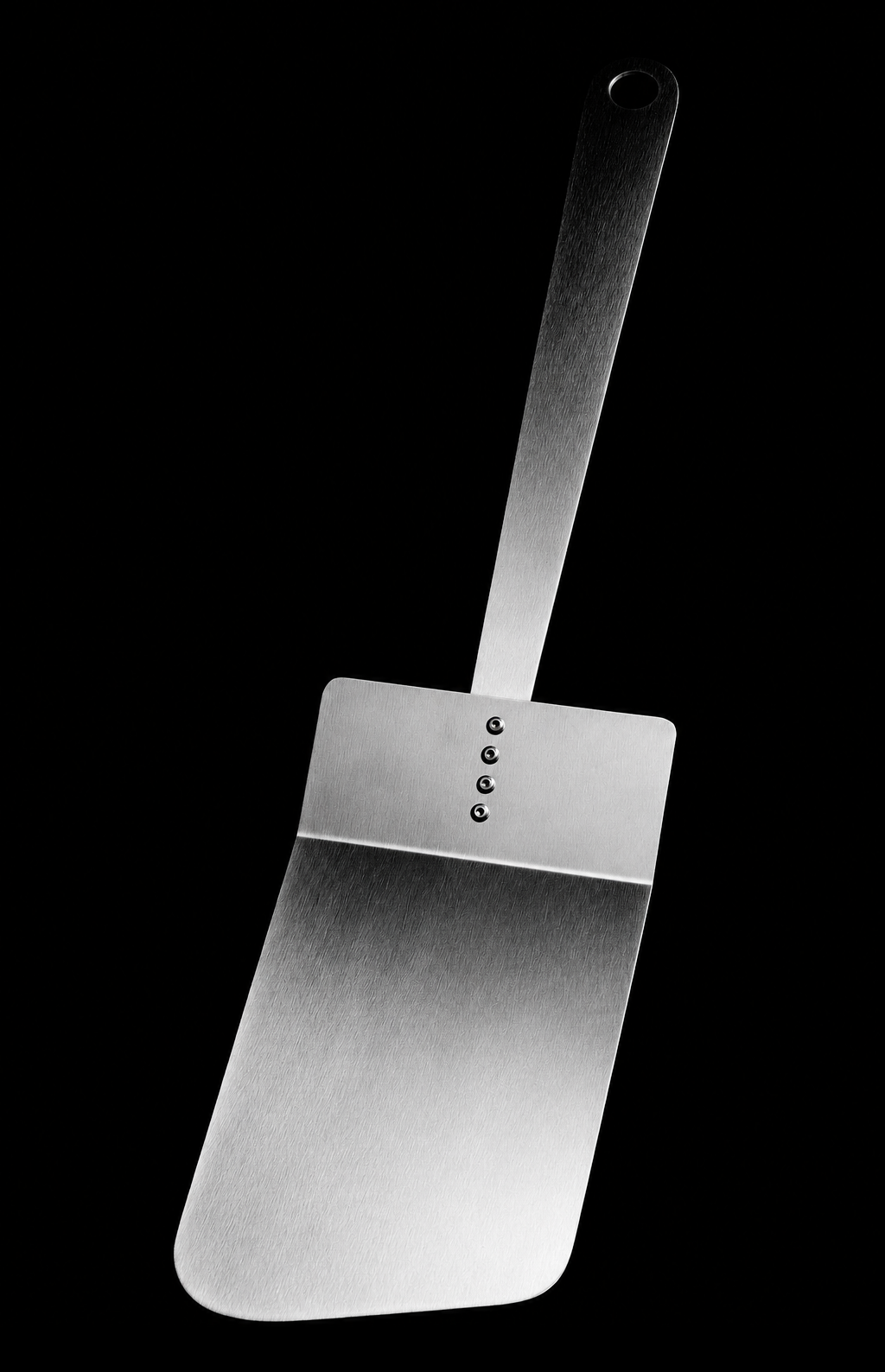
Mike Draper Spatula_ An ultra light spatula, handmade in Wyoming from grade 5 (Ti 6AL-4V) titanium alloy. Only 0.5mm thick, the head is flexible enough to bend 90 degrees and yet strong enough to spring back to its original shape. Sourced from the Material Sourcebook for Design Professionals_ P. 64
Titanium’s unique properties affect how a product feels and behaves. Low thermal conductivity can reduce heat transfer through a utensil handle, while titanium’s springiness can aid in achieving desirable characteristics for certain products, such as in the spatula above or can replace conventional hinges or fasteners in eyewear.
Its protective oxide layer reduces the need for maintenance and can be manipulated to produce durable colours without paint or dye. This is achieved through electrolytic oxidation, often called titanium anodising, which is the controlled growth of it’s oxide layer, using electric current .
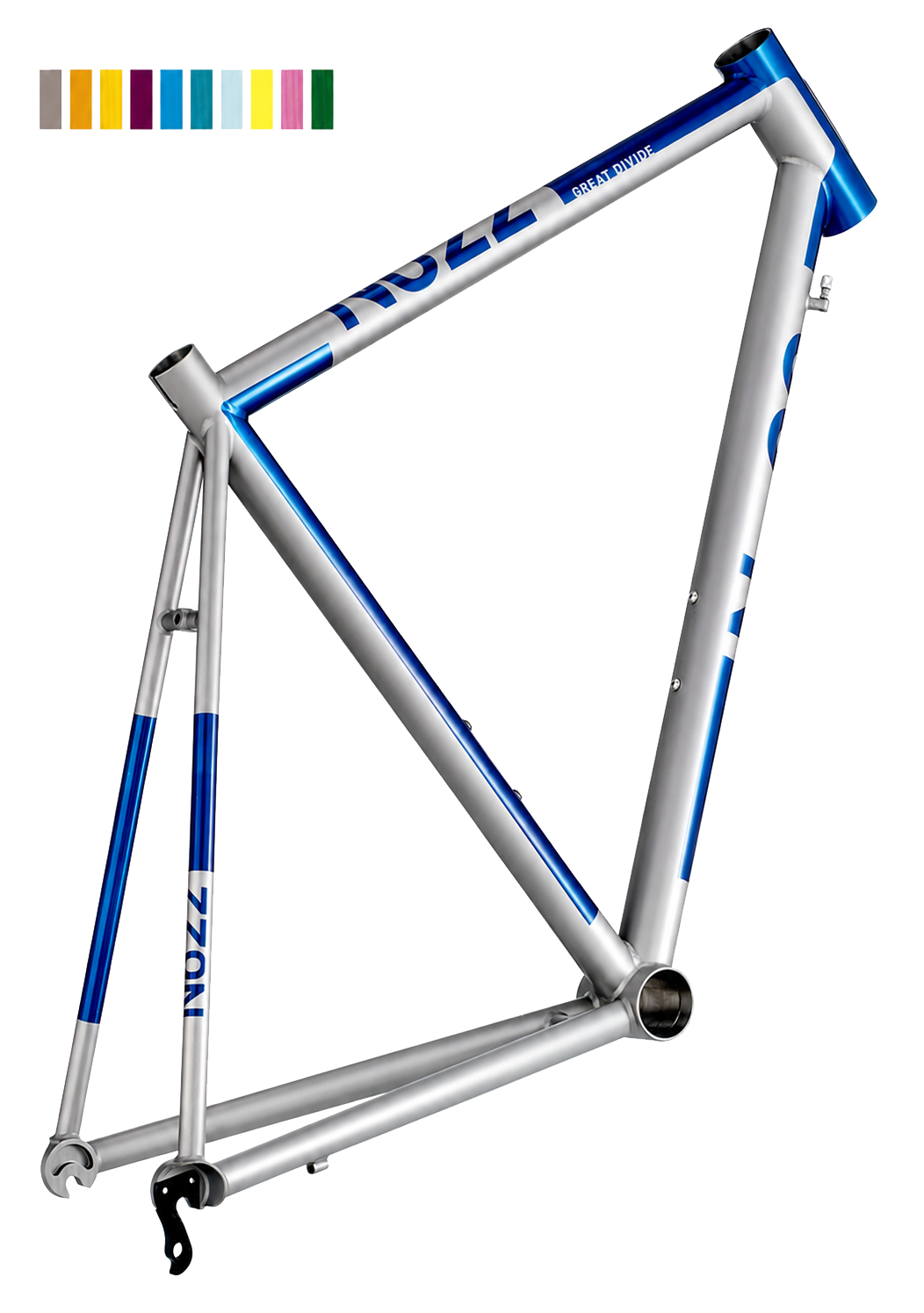
Electrolytically coloured titanium bicycle frame_ Adjusting the thickness of titanium’s oxide layer produces durable colours through light interference rather than pigments or paint. Sourced from the Material Sourcebook for Design Professionals_ P. 61
Titanium can be forged, rolled, formed, cast, CNC machined, waterjet cut, welded and additively manufactured (3D printed). It can be polished to a mirror finish, etched or blasted to a soft matt texture.
Structural ‘sandwich’ panels have far higher strength and stiffness-to-weight ratios than a simple sheet of material. Increasing the thickness by a factor of four using honeycomb core will yield a material nearly 10 times stronger and 35 times stiffer, and yet, only a fraction heavier.
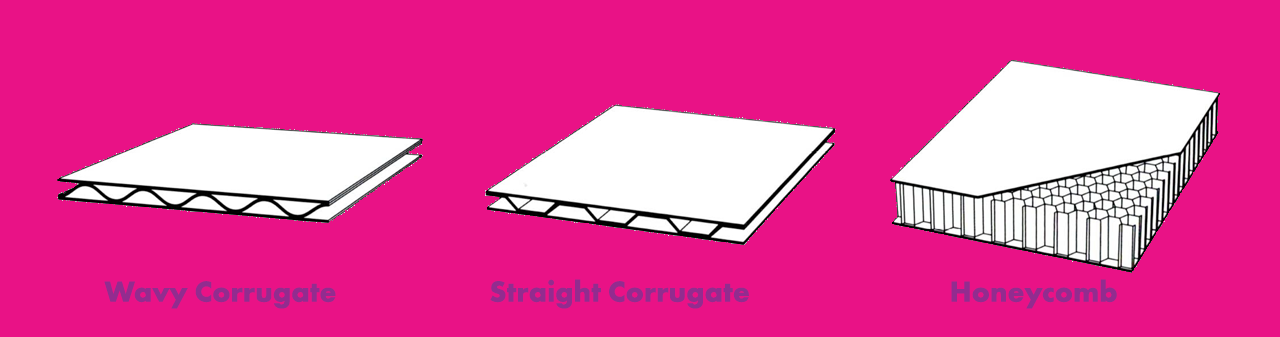
Structural Panels imagery_ Sourced from the Material Sourcebook for Design Professionals_ P. 62_ Edited by Tomás Agnew
Titanium is used in aircraft, spacecraft, turbines, marine equipment, chemical processing, medical implants, surgical instruments, bicycles, eyewear, architecture and premium consumer products.
Primary titanium production has high embodied energy and produces significant waste, so recycling is economically attractive, but grade separation, oxygen contamination and certification requirements can prevent scrap from returning to equivalent safety-critical applications, but generally can be used in construction.
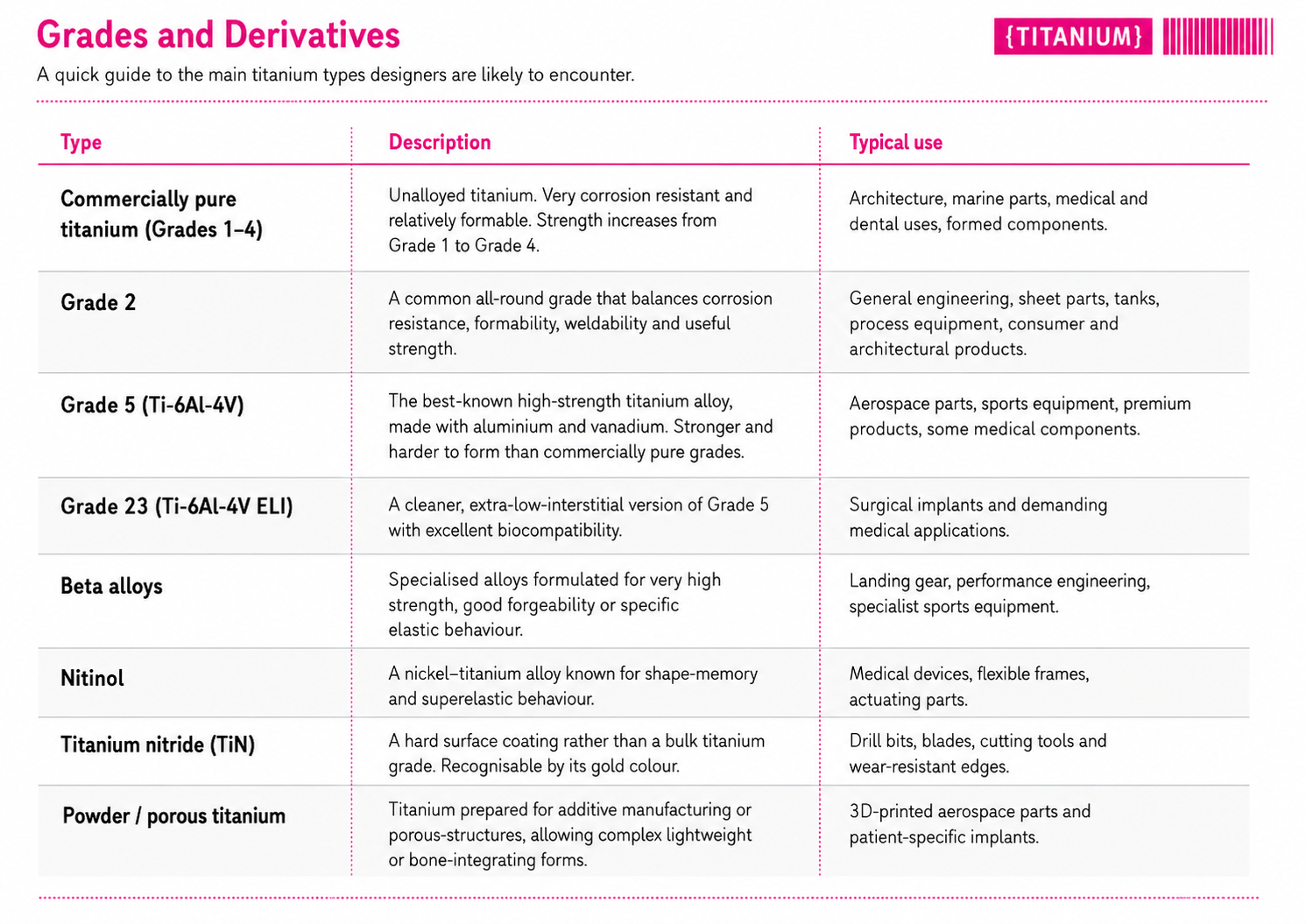
Titanium Grades and Derivatives_ and their typical uses.
Titanium is one of the few materials that are fully compatible with the human body. Once implanted it is not affected by bodily fluids or tissue and becomes fully osseointegrated (the direct structural and functional connection between living bone and the surface of a load-bearing artificial implant), we call this biocompatibility.
Medical professionals have a range of grades to choose from, from the more ductile (ability to be drawn into thin wire - 3D printable) to tensile strengths over 1000 MPa (equivalent to 10,200 kg per square cm). Grade selection depends on the needs of the individual, and the part is suited to specific applications.
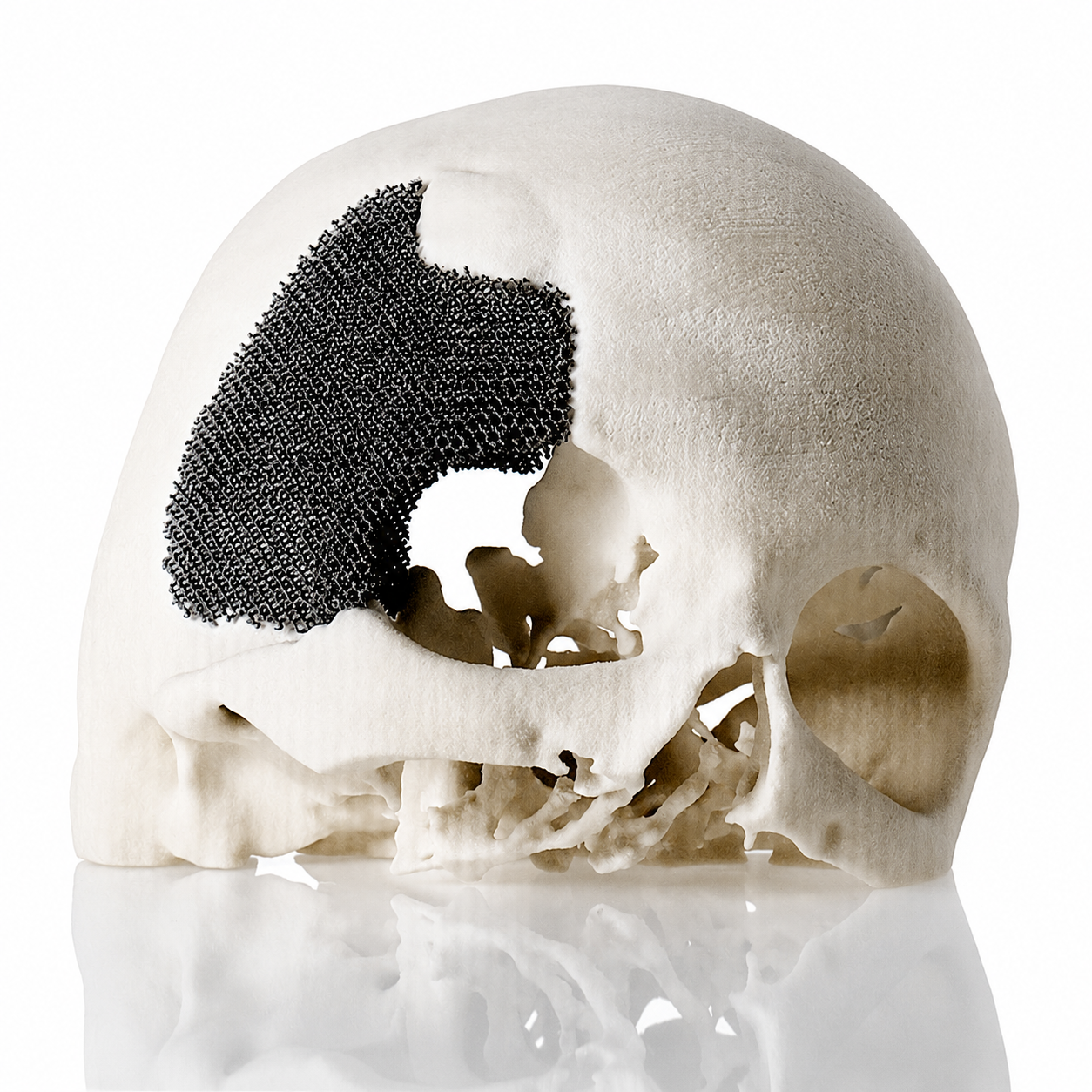
Arcam EBM Technology_ Custom lattice skull implant made with additive manufacturing. Implants can be made using data from CT scans, the computer tomography data creates an exact representation pf the implant. The EBM machine uses this data to build the part, ensuring an exact fit. Trabecular (rod-lie) structures improve osseointegration. Sourced from the Material Sourcebook for Design Professionals_ P. 65
Costs per KG:
Commercially Pure Industrial Plate: €9.50 - €22.40/kg depending on thickness.
Grade 5 Industrial Plate: €17.10 - €29.00/kg.
Small Volume European Grade 2 Sheet: Approx. €76/kg.
Finished or Certified Components: Usually quotation-based.
Sources / Further Reading:
Chris Lefteri, Materials for Design. P182-183 Link to book: Materials for Design - Chris Lefteri - 978178067344, Link to Chris Lefteri’s website, where you can find interesting articles and further research: CMF Industry-Leading Material Reports | Chris Lefteri Design — Chris Lefteri Design
Rob Thompson, The Materials Sourcebook for Design Professionals. P58-65 Link to book: The Materials Sourcebook for Design Professionals - Rob Thompson - 9780500518540
Medical Grade Titanium Classification ASTM F136 specification defines Ti-6Al-4V ELI as an extra-low-interstitial alloy for surgical implant manufacture; ATI also identifies it as Grade 23.
The Kroll Process & Titanium Recovery Sustainability and Circularity, A 2024 peer-reviewed paper.
Direct Recycling of Titanium Scrap Shear Assisted Processing and Extrusion, A 2024 Pacific Northwest National Laboratory report.
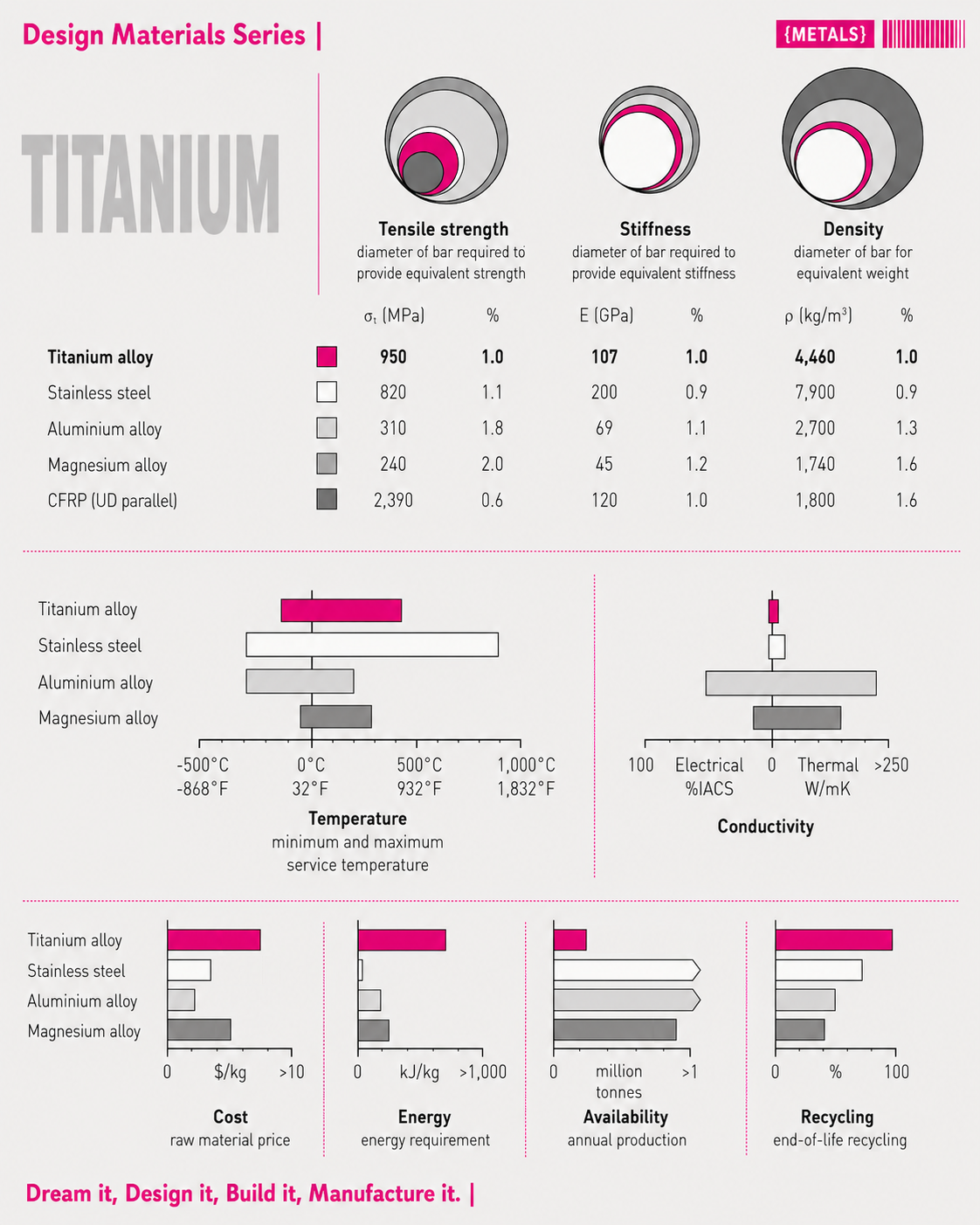
Titanium Datasheet_ Sourced from The Materials Sourcebook for Design Professionals P. 58_ Colours & Layout edited by Tomás Agnew.
Team Human supports clients with material selection, industrial design, prototyping, CMF development, design for manufacture, supplier and process decisions, and circular-design planning from our studio based in Wicklow, Ireland. Contact Team Human at info@teamhuman.ie.
#Titanium #TitaniumDesign #MaterialDesign #DesignMaterials #ProductDesign #IndustrialDesign #IrishDesign #CMFDesign #Prototyping #DesignForManufacture #AdvancedManufacturing #MetalManufacturing #AdditiveManufacturing #MedicalDeviceDesign #AerospaceDesign #SustainableMaterials #CircularDesign #CircularEconomy #MaterialsResearch #TeamHuman
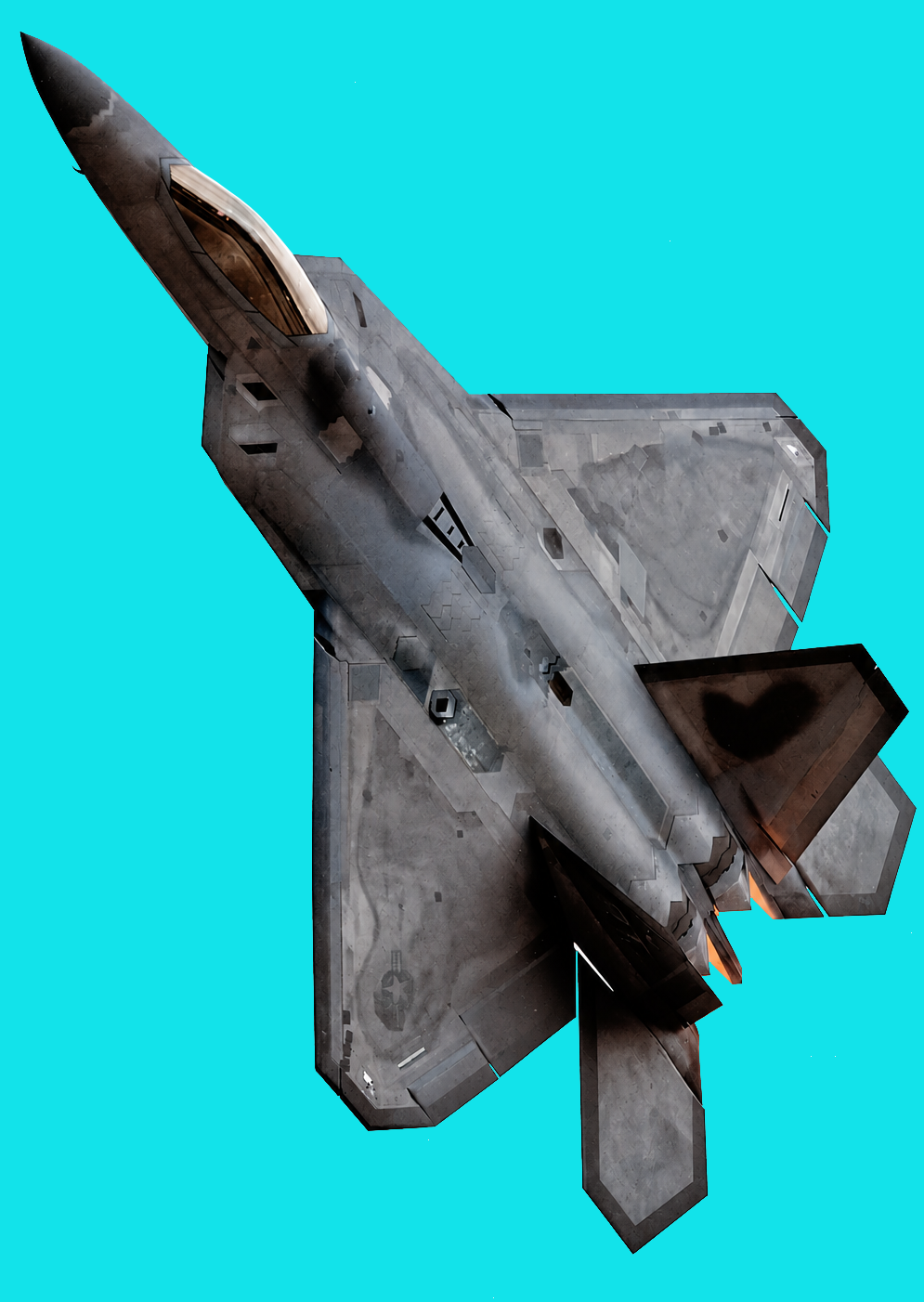
Lockheed Martin F-22 Raptor_ Aerospace engineering pushes materials to their limits. Titanium alloy and titanium composite materials are used in the frame, bulkheads and other components that require high strength-to-weight and heat resistance, giving it the ability to perform aerial manoeuvres without the added weight associated with other durable materials. Sourced from the Material Sourcebook for Design Professionals_ P. 63