
Concept Research: Deep Understanding
Good design doesn’t start with an answer. It starts with understanding and asking the right questions. In human-centred design, the early research phase is about building an explicit understanding of users, their tasks and the environments in which a product will be used. That is what helps a project move from assumption to evidence.
At Team Human, concept research begins with a one-to-one sit-down with you where we clarify the brief. What is the product meant to do? Who is it for? What job is it helping someone get done? This matters because user experience is not just the object or interface itself, but the full experience a person has with a product or service.
From there, we look outward. We do competitor analysis, review adjacent sectors, materials, technologies, and potential manufacturing routes. This kind of discovery work helps uncover what already exists, where the gaps are, and where there may be room to create something useful, intuitive, or commercially relevant. The British Design Council’s famous Double Diamond frames this as moving first through a wide-casting discovery phase, which is then refined down into a clearer problem definition.
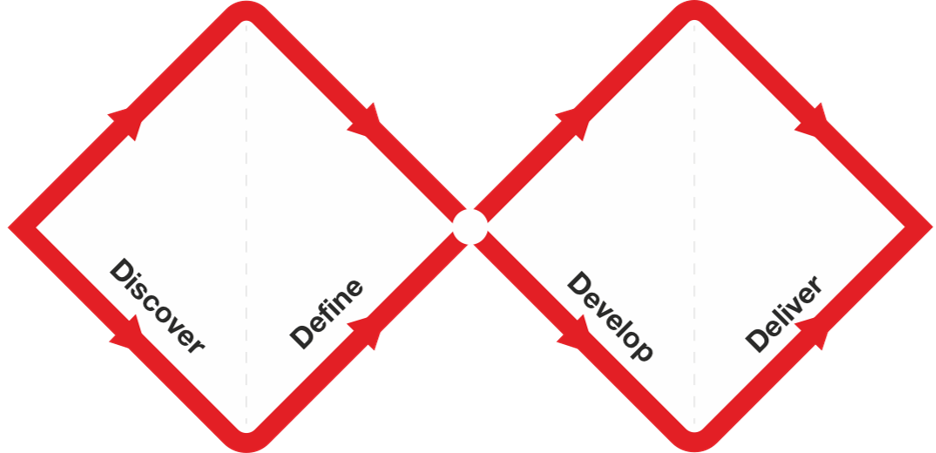
Design Councils Double Diamond
We also test ideas against reality early. Different research methods answer different questions, so the process may include desk research, user interviews, observational research, early concept reviews or usability thinking, depending on the challenge. The goal is to reduce risk before development begins.
The outcome of concept research is not a finished design. It is a better brief, clearer design criteria, and stronger direction for concept generation. Done properly, it helps us suggest better decisions earlier in the design process and gives your new product a far better chance of succeeding in the real world.
Sources & Further Reading:
Design Council. The Double Diamond and Framework for Innovation — useful support for the discover/define/develop/deliver structure. https://www.designcouncil.org.uk/our-resources/the-double-diamond
Nielsen Norman Group. The Definition of User Experience (UX) by Don Norman and Jakob Nielsen — strong source for the idea that design must consider the full end-user experience. https://www.nngroup.com/articles/definition-user-experience
Nielsen Norman Group. When to Use Which User-Experience Research Methods — useful support for discussing different research methods during concept research. https://www.nngroup.com/articles/which-ux-research-methods
Nielsen Norman Group. Usability 101 — useful for supporting usability as an early design consideration. https://www.nngroup.com/articles/usability-101-introduction-to-usability
Contact us today at info@teamhuman.ie or on our website www.teamhuman.ie
Team Human is a Product design and innovation consultancy based in Wicklow,
Ireland. Team Human can create prototypes of varying levels depending on project
requirements and budget from rapid foam models to slick high-end demo products.
#TeamHuman#ProductDesign#ConceptResearch #DesignProccess #DesignLearning #DesignBlog #DesignSeries #DesignInnovation#Ireland#Dublin#Wicklow#IndustrialDesign #Innovation#DesignAgency#DesignThinking#3DPrint#Workshop#Prototype#RapidPrototyping#Design#IrishDesign#SketchModel#Startup#SupportLocal#Technology#Advancement#Realize#Idea#DesignerMaker#Product#DesignLeaders