
A product teardown is one of the most practical ways to understand how a product really works.
At Team Human, a good teardown begins with defining the objective. Are we benchmarking a competitor, investigating usability issues, improving assembly, or looking for innovation opportunities? Then we look at the product as a user would: how it feels, how intuitive it is, where friction appears, and what the experience suggests about quality, durability, and value. That early framing matters, because a teardown is most useful when it is tied to a clear problem, user need, or design question.
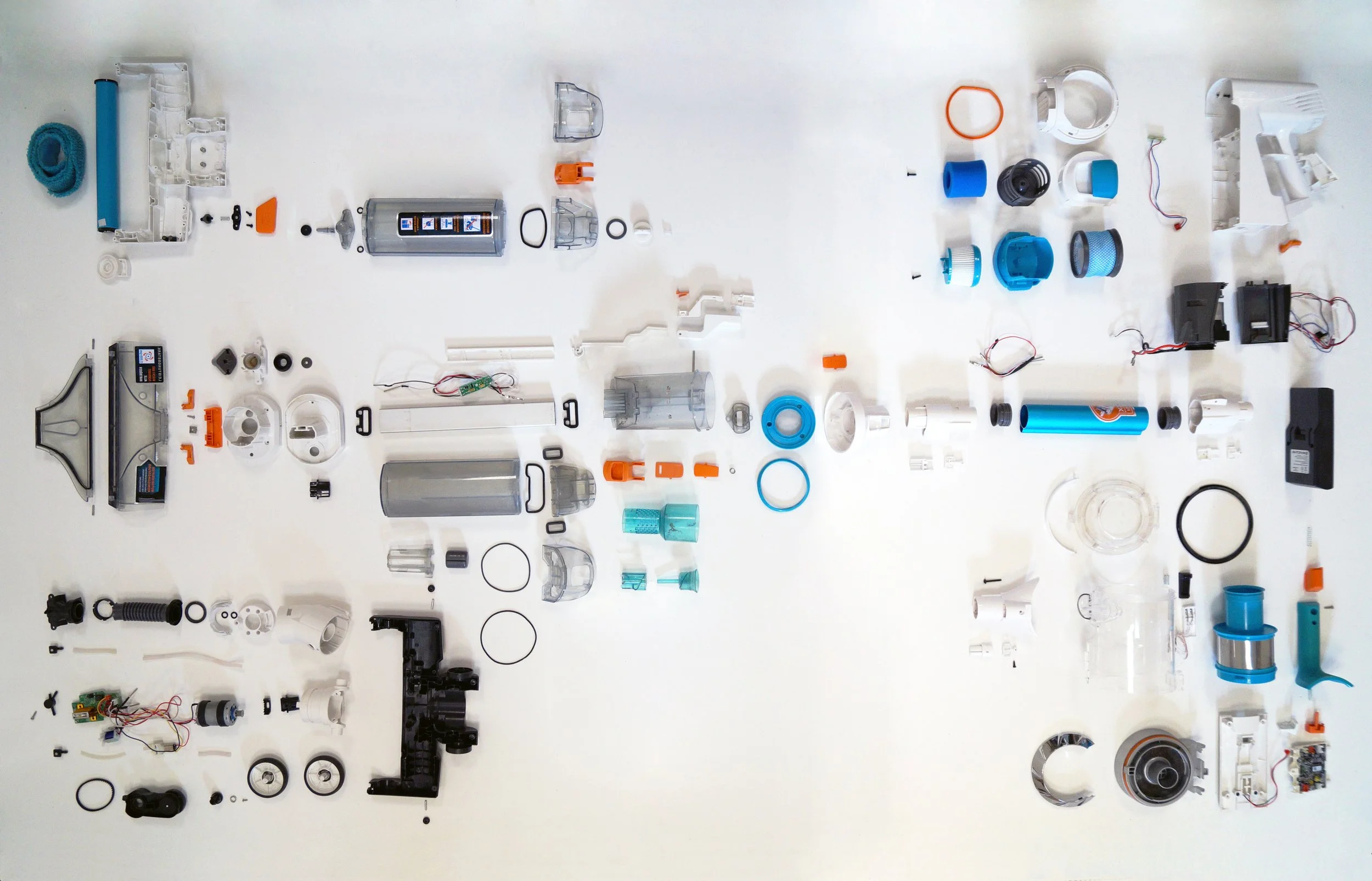
Product Teardown and competitor analysis of a wet-vacuum
From there, we gather context. That can include packaging, instructions, marketing claims, customer reviews, and any clues about the intended user journey. With complex physical products, such as medical devices, or with digital products, a user journey map may be required to understand each intended user action and highlight potential snagging points. Then, a careful documentation process of each step, which could be a physical disassembly, or user flow and interaction analysis of a UI. We study fixings, count parts, internal layout, wall thicknesses, materials, finishes, electronics, and assembly logic. We also look for feature gaps, hidden pain points, and the relationships between components, because that is often where the real lessons are found.
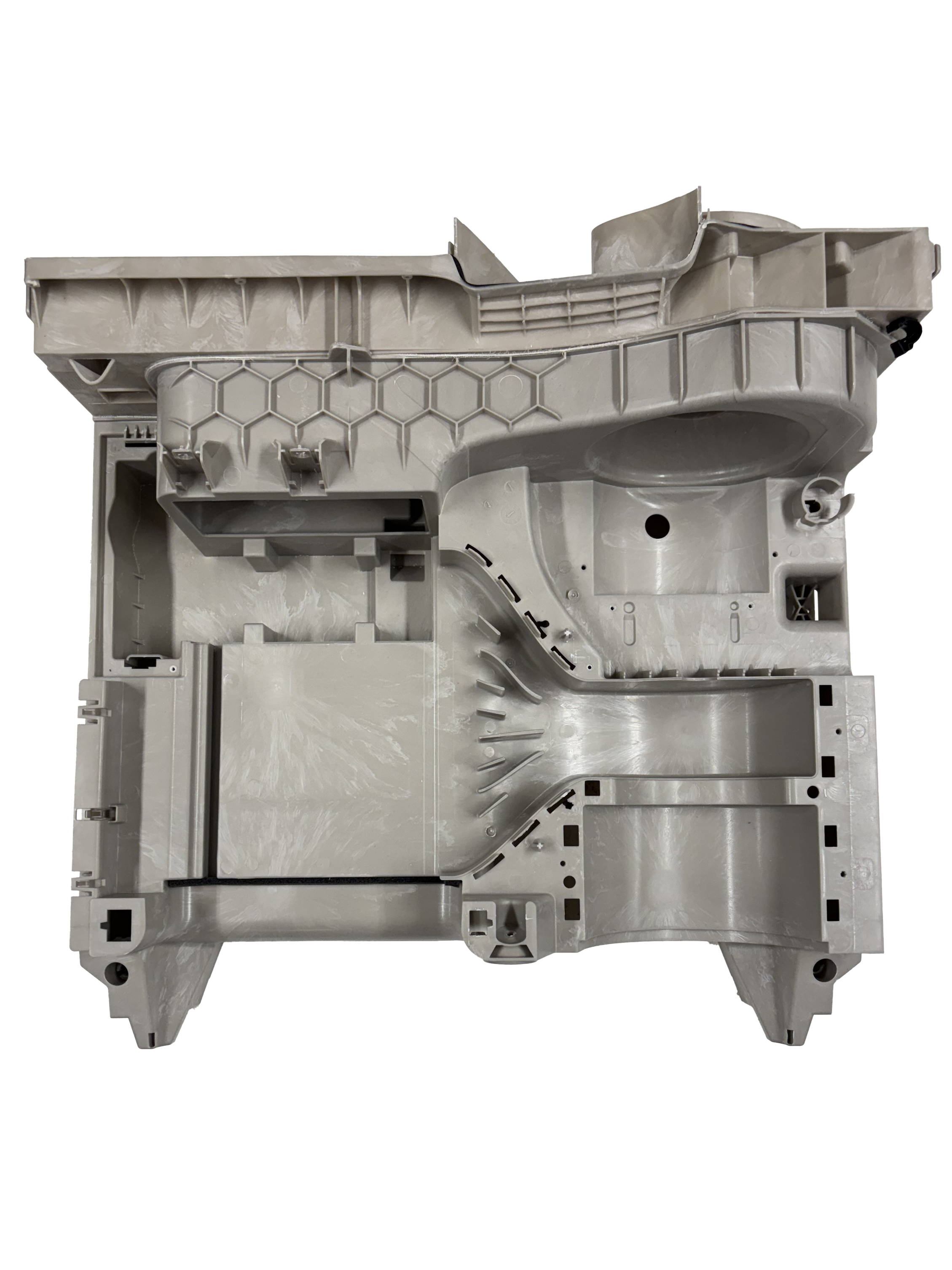
Product teardown of a clothes drying machine showing the internal airflow route and showing us the placement of the motor, condenser, fans and water pumps
This process improves design by replacing assumptions with evidence. It shows what has been done elegantly, what has been overcomplicated, and where small changes could improve usability, manufacturability, repairability, or cost. It also speeds up product development. Instead of starting from a blank page, we can learn quickly from existing products, prioritize recommendations, and move faster toward better-informed design decisions. In that sense, a teardown is not just analysis. It is a shortcut to clearer thinking.
Sources / Further Reading:
M3Design. Design consultancy in Texas, USA, with excellent articles and learning resources on their website: Speed up product development with product teardowns
Raj, A. Medium. Link to article: How To Do Product Teardowns Without Feeling Like An Imposter | by Aditya Raj | Product Marketing | Bootcamp | Medium
Lohmar, P. Medium. Link to article: From Good to Great: How Feature-Gap Analysis Transforms Your Product | by Philipp Lohmar | Medium
Jay, P. Medium. Link to article: User Journey Mapping: A Beginner’s Guide | by Jay Patel | Bootcamp | Medium
Mohan S, R. LinkedIn. Link to article: (2) A Step-by-Step Guide to Product Teardown for real world products | LinkedIn
Gandhi, K. Product Space. Useful article on UI/UX Product teardowns. Link to article: How To Do Product Teardown
IFIXIT. Website with useful teardowns of some IOT (Internet of Things) gadgets: Gadget Teardowns - iFixit
Wokoo Design. Design Consultancy with useful product teardown insights page: Product Teardown & Engineering Breakdown Insights
Do you need an in-depth product teardown & analysis done on an existing competitor product? Let Team Human be your guide in helping you discover new opportunities for IP and innovation. Contact us today at info@teamhuman.ie or visit our website www.teamhuman.ie to explore how we can help you.
Based in Wicklow, Ireland, Team Human is a leading product design and innovation consultancy. Our expertise spans industrial design, medical devices, and more. Join us on this exciting journey of innovation, and let's shape a better future together.
#TeamHuman #ProductDesign #Ireland #Dublin #Wicklow #IndustrialDesign #MedicalDevices #Innovation #DesignAgency #ProductTeardown #CompetitorAnalysis #Workshop #Prototype #IrishDesign #SketchModel #Startup #SupportLocal #Technology #Advancement #Realize #DesignerMaker #Product #Materials