
Cast Iron: Complex Shapes at a Low Cost
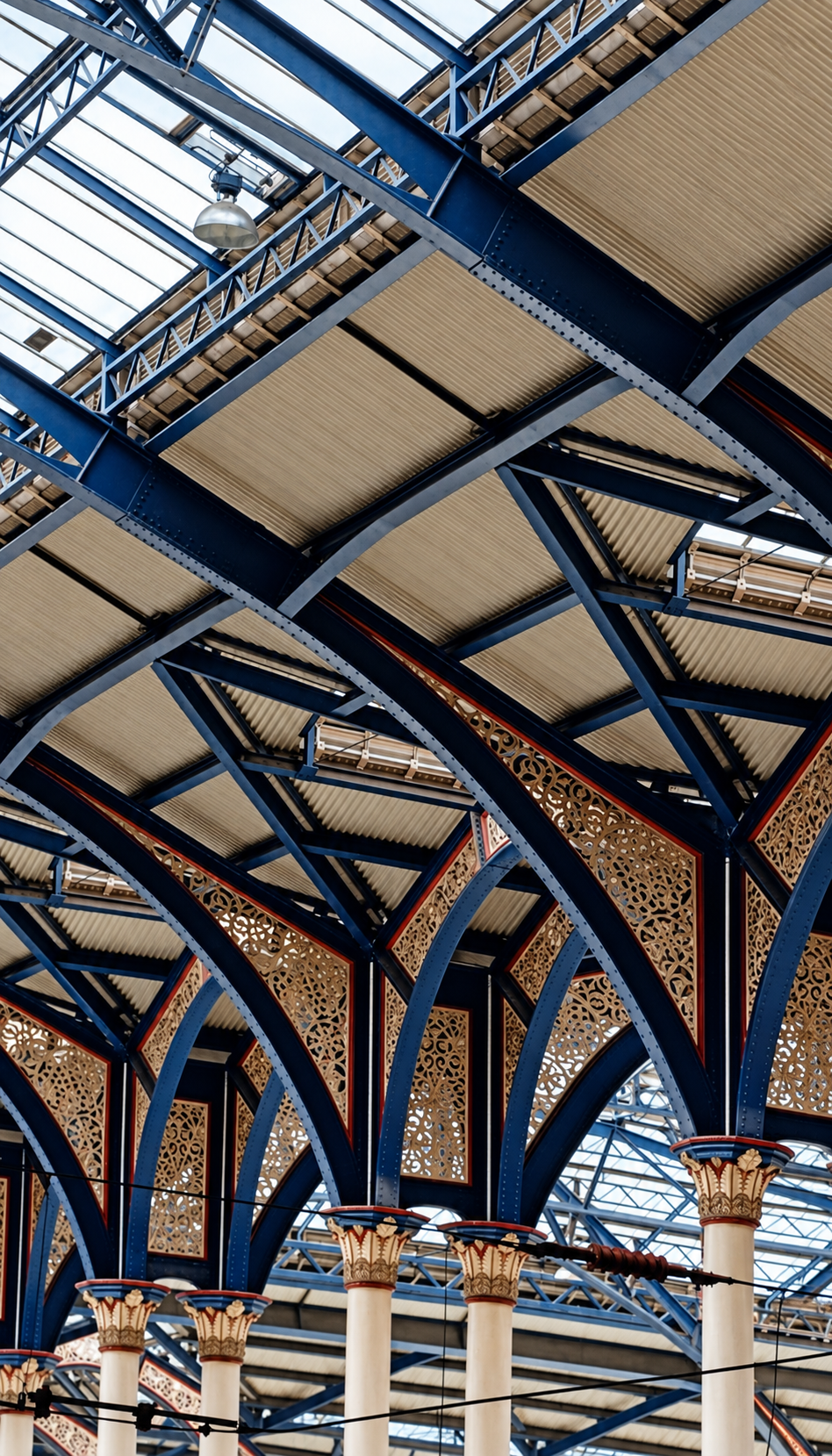
Cast-Iron Station Roof, Liverpool Street Station_ The Gothic-style train shed was designed by the engineer Edward Wilson and opened in 1875. Wrought-iron spans sit on cast-iron columns, and the detailing — sturdy capitals, highly figured roof supports — is accentuated with colour. It is the argument for cast iron in one image: casting complex ornament cost almost nothing extra, which is why Victorian architecture looks the way it does. Sourced from Rob Thompson, "The Materials Sourcebook for Design Professionals" (Thames & Hudson), P. 22–27
Cast iron is iron with carbon in it, and that carbon defines the metal. Steel keeps carbon below 2%, and good quality is always below 1%. Cast iron runs between 2 and 4%, with a little silicon added. That extra carbon drops the melting range to roughly 1,150–1,300°C, comfortably below steel's, and it makes the molten metal remarkably fluid. The result is a ferrous, magnetic, stiff, and dense metal at around 7,100–7,200 kg/m³.
The same carbon that makes it castable makes it brittle. In grey iron the carbon sits as graphite flakes threaded through the metal, and those flakes act like microscopic notches — stress concentrates at their tips, and cracks travel from there. Grey iron is very strong in compression and comparatively weak in tension, so it fails in bending rather than stretching. It cannot be forged at all. And it rusts, though more slowly than steel does.

Graphite Microstructure_ Flake, Spherical and Vermicular_ The shape the graphite takes inside the metal decides how the part fails, because failure begins at the graphite. The flakes in grey iron offer almost no ductility, as stress concentrates at their tips. Ductile iron's spherical nodules do not build stress to the same level, giving higher tensile strength and elongation. CGI's vermicular structure — blunt, interconnected flakes — combines the useful properties of both. Sourced from Rob Thompson, "The Materials Sourcebook for Design Professionals" (Thames & Hudson), P. 22–27
Because cast iron is very fluid when molten and shrinks very little as it cools, it will reproduce intricate detail and handle thick and thin wall sections in the same part. Complex geometry that would be several operations in steel arrives in a single step, and the detailing costs little or nothing extra. Machining then brings the part to accurate dimensions, and how well it machines depends on the graphite microstructure.
For a designer, cast iron behaves unlike almost anything else you will specify. Its thermal conductivity is poor, so it develops hot spots and takes its time heating up. But its heat capacity is high, so once it is hot it stays hot, and its emissivity is high too, so it radiates that heat back into whatever is sitting on it. That combination is why cast iron cooks evenly and sears properly.
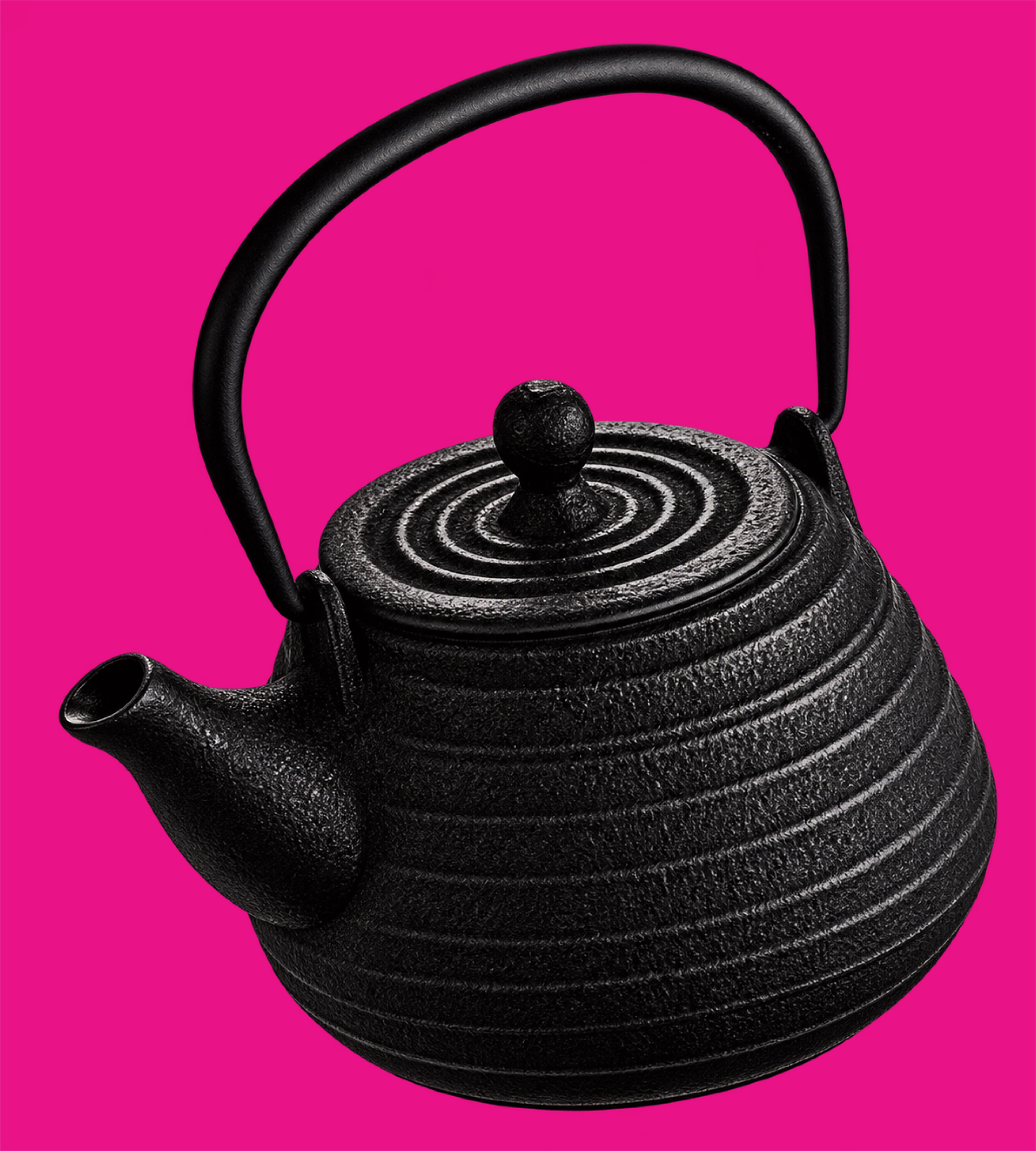
Cast-Iron Teapot_ Cast-iron teapots date to at least 17th-century China and Japan, and became status symbols in Japan as their decoration grew more elaborate. The material earns its place through heat capacity rather than conductivity: the pot is slow to heat and then holds that heat, which is what full-leaf green tea wants. The inside is sometimes enamelled to stop the iron corroding. Sourced from Rob Thompson, "The Materials Sourcebook for Design Professionals" (Thames & Hudson), P. 22–27
It is also exceptionally good at absorbing vibration. Grey iron quells vibration far more effectively than steel or aluminium by converting mechanical energy into heat, which is why machine bases, engine blocks and brake drums are still made from it. And because it is used in thick sections, it does not warp when heated.
The four key types:
Grey iron is the cheapest and most common, with flake graphite: low strength, excellent damping, high thermal-shock resistance, high compressive strength, and it machines easily.
Ductile iron adds magnesium to pull the graphite into tiny spheres, giving markedly higher tensile strength and elongation, which suits brake discs, crankshafts, gears and pressure-containing valve and pump bodies.
Compacted graphite iron (CGI) sits between the two, with about twice grey iron's tensile strength and still has enough castability to be the chosen material for modern diesel engine blocks.
Alloy irons add chromium, molybdenum or nickel for wear, corrosion or heat resistance, and cost more to make. Two derivatives, SiMo ductile iron holds up at continuous operating temperatures of 600°C and above, and austempered ductile iron (ADI) is around twice the strength of standard ductile iron, with better strength-to-weight than aluminium and wear resistance equivalent to steel.
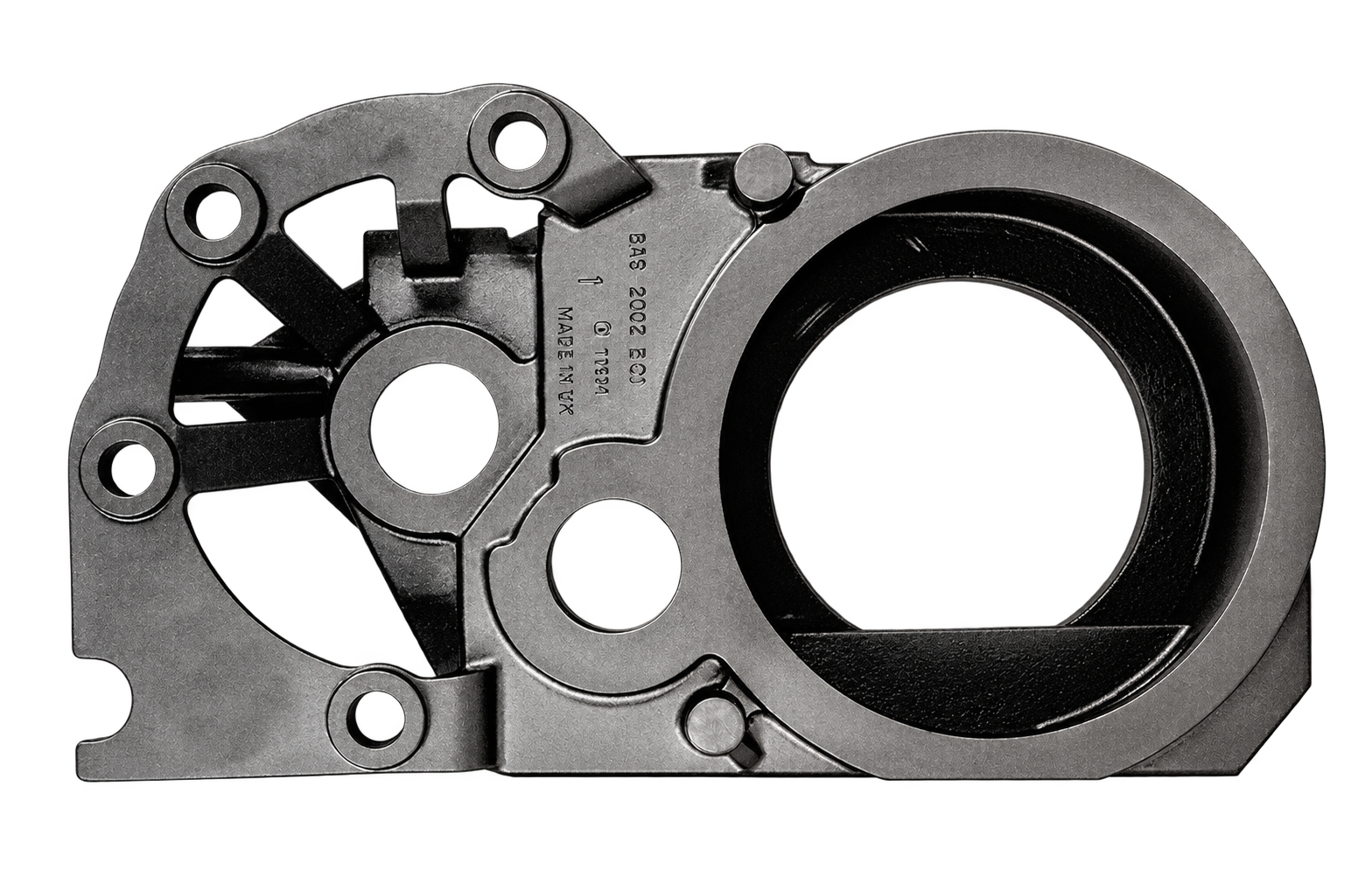
Sand-Cast Ductile Iron Gearbox Housing_ This underground train gearbox part weighs 115 kg. Ductile iron casts at a lower temperature than steel, which allows a better surface finish and more complex shapes with changing wall thickness — the reason a part like this is cast rather than fabricated. Photograph: courtesy of BAS Castings, UK. Sourced from Rob Thompson, "The Materials Sourcebook for Design Professionals" (Thames & Hudson), P. 22–27
There are trade-offs, grey iron's flake graphite gives it low fatigue strength, which matters for anything loaded and unloaded continuously. Its mechanical properties fall away at relatively low elevated temperatures, so load-bearing ironwork is vulnerable in a fire; over-reliance on iron's strength caused catastrophic failures through the 19th century. It is also poor in corrosion resistance unless painted, enamelled or alloyed, and mining the ore carries a real environmental cost.
On energy, producing iron takes around two-thirds the energy of steel, 10% of brass, and 6% of aluminium. It is recyclable, widely collected and widely reprocessed — the end-of-life recovery rate is high, helped by the fact that it is magnetic and therefore easy to separate. The general rule would be to specify grey iron where compression and damping do the work, move to ductile only where fatigue or tension demands it, and do not reach for alloy irons if a plain grade will do
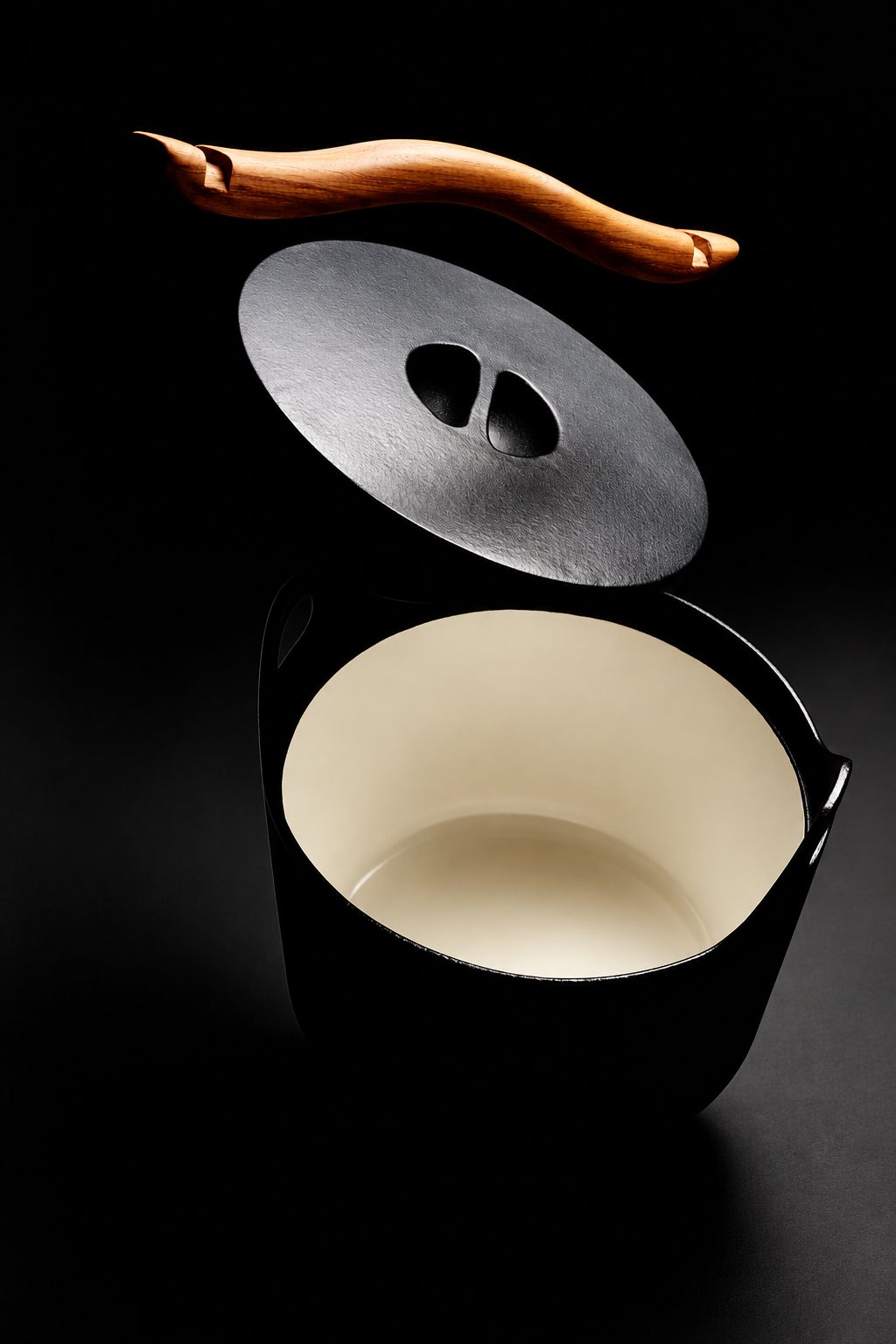
Sarpaneva Enamelled Cast-Iron Pot_ Designed by Timo Sarpaneva for Iittala in 1960 and still in production. The detachable wooden handle lets the pot move from hob to oven, and it works on every type of appliance including induction. The enamelled surface stops food sticking and makes it easier to maintain. Sourced from Rob Thompson, "The Materials Sourcebook for Design Professionals" (Thames & Hudson), P. 22–27
Costs per KG:
When it comes to metals, costs are hard to estimate because grade, form, finish, quantity, and alloy surcharges move constantly, as do delivery costs, so live supplier quotes are essential.
Machinable bar, cut to size. Grade 250 grey iron round bar from metals4U, quoted 18 September 2026, ex VAT, converted at GBP/EUR 1.1661 and calculated at 7,200 kg/m³:
90mm Ø — €6.70/kg
100mm Ø — €6.97/kg
60mm Ø — €7.95/kg
70mm Ø — €9.11/kg
50mm Ø — €10.20/kg
80mm Ø — €12.64/kg
Notice the pricing is not consistently increasing: 80mm is nearly twice the per-kilo cost of 90mm. Look for the diameter the stockist has depth in, the price you pay will be reflected in the current stock levels.
For comparison, mild steel at €3.6/kg from a comparable supplier, puts cast iron bar at roughly two to three-and-a-half times mild steel’s cost — but is much easier to cast, which can make it cheaper overall.
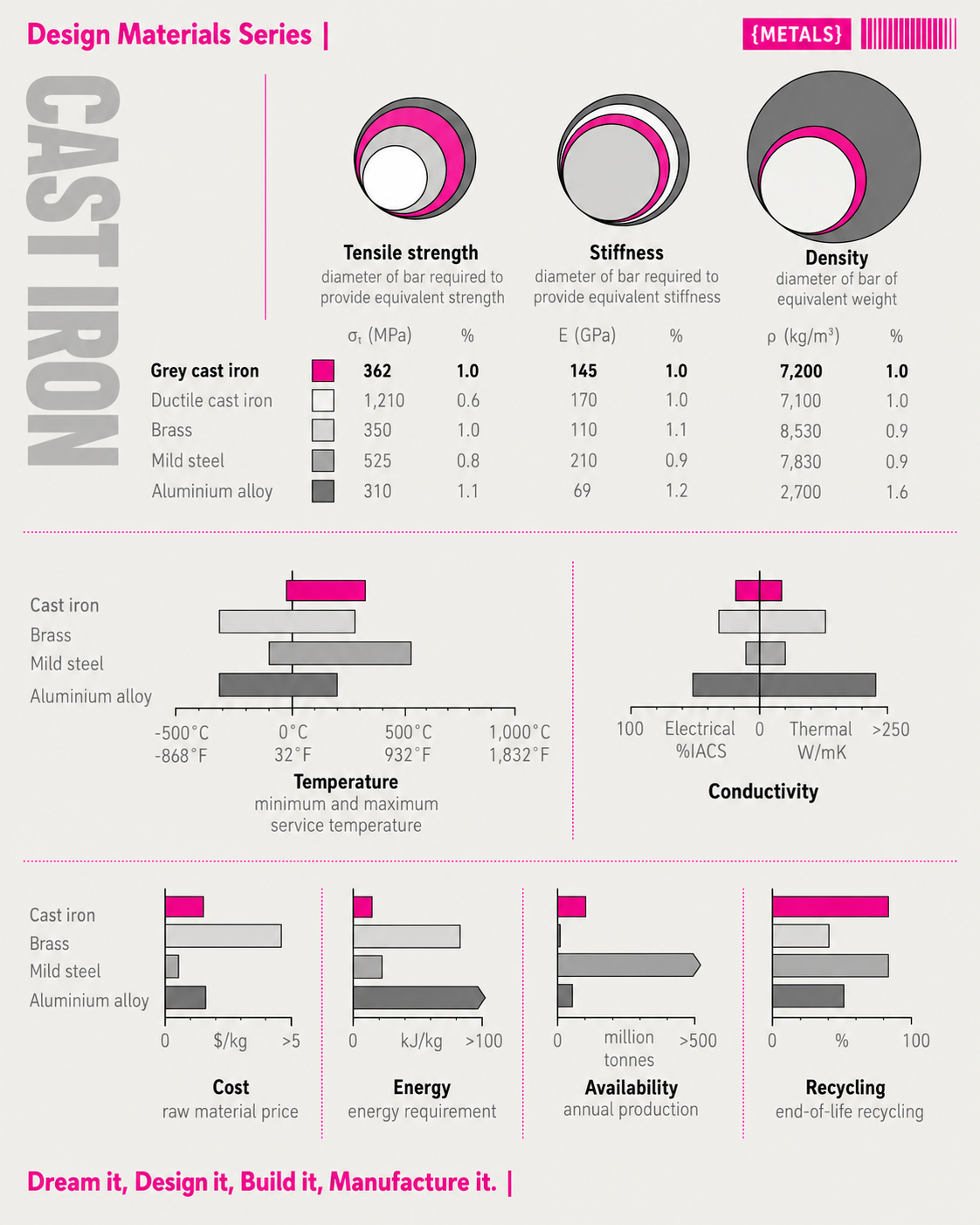
Cast Iron Datasheet_ Property comparison against brass, mild steel and aluminium alloy — tensile strength, stiffness, density, service temperature, conductivity, cost, embodied energy and recycling rate. Sourced from Rob Thompson, "The Materials Sourcebook for Design Professionals" (Thames & Hudson), P. 22. Colours & Layout edited by Tomás Agnew
Sources / Further Reading:
Chris Lefteri, Materials for Design. P194–195. Materials for Design — Chris Lefteri — 978178067344.
Rob Thompson, The Materials Sourcebook for Design Professionals. P22–27. The Materials Sourcebook for Design Professionals — Rob Thompson — 9780500518540
Steel Express, technical specification for EN-GJL-250 grey cast iron to BS EN 1561 (2011), equivalent to ISO 185 (2005): Grade 250 Cast Iron bar
metals4U, Grade 250 cast iron round bar pricing, retrieved 18 September 2026: Cast Iron Round Bars
If you are weighing cast iron against fabricated steel, an aluminium casting or an engineering thermoplastic, the question is usually whether the part needs compressive strength, damping and thermal mass more than it needs toughness and light weight. Team Human can help you work that decision through — material selection, casting method, wall-section and draft strategy, finishing and supplier choice — from our studio in Wicklow, Ireland. Contact Team Human at info@teamhuman.ie.
#TeamHuman #ProductDesign #IndustrialDesign #MaterialDesign #CastIron #GreyIron #DuctileIron #SGIron #CGI #SandCasting #InvestmentCasting #FerrousMetals #Cookware #AutomotiveDesign #EngineeringMaterials #MaterialResearch #CMFDesign #DesignForManufacture #Prototyping #CircularDesign #DesignForRecycling #MadeInIreland #Ireland #Wicklow